


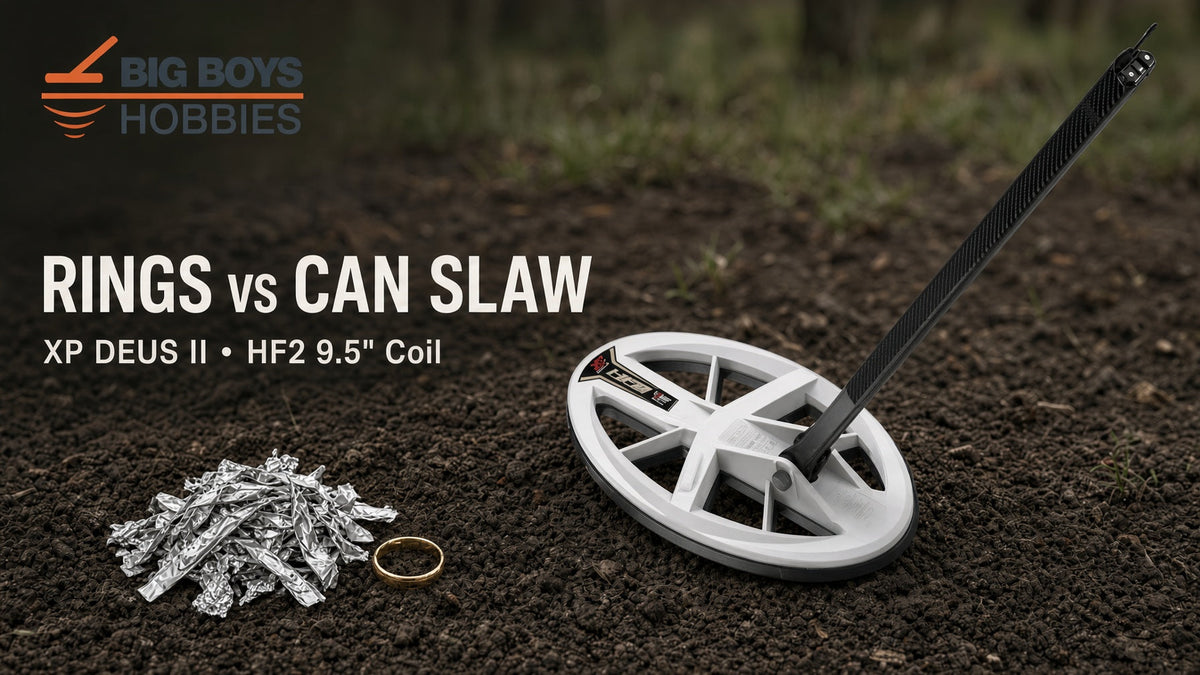
From my initial testing and years of metal detecting, if you hunt parks, tot lots, concert grounds, or other trashy sites with an XP DEUS II, you know the problem: foil and shredded aluminum cans can sound a lot like the gold rings you hope to find. With the XP HF2 9.5" × 5" elliptical coil, you can compare a target’s ID in two frequency ranges before deciding whether to dig.
The idea is simple: When I tried searching with a 29 kHz maximum-frequency program. When you find a promising, isolated target, switch to an otherwise identical 89 kHz program. A repeatable rise in target ID may be a clue that the target is a continuous metal loop, such as a ring. Many pieces of flat foil and can slaw show little or no rise.
This test does not identify gold. An intact pull-tab ring, metal grommet, or another closed loop may behave like a jewelry ring. It is one more clue for selective digging, not a guarantee.
Exact XP DEUS II HF2 Settings: Make Two Programs
This worked best for me. Start with the General program and save two copies. Match every setting below except maximum frequency and frequency shift. Save the programs next to each other so you can switch between them quickly over a target.
| Setting | Program 1: Search | Program 2: Check |
|---|---|---|
| Base program | General | General |
| Maximum frequency | 29 kHz | 89 kHz |
| Frequency shift | 0 | 6 |
| Discrimination | 8 | 8 |
| Silencer | 2 | 2 |
| Sensitivity | 92 | 92 |
| Iron Volume | 4 | 4 |
| Reactivity | 2 | 2 |
| Tones | Full Tones | Full Tones |
| Bottle Caps | 3 | 3 |
| Full Tones offset | 5 | 5 |
These are the settings used for the comparison, not a factory preset or a universal best program. Ground balance at your site. If sensitivity 92 produces an unstable detector, reduce it as needed and keep the two saved programs matched.
How to Check a Possible Gold Ring Signal
- Search with Program 1. Use the 29 kHz maximum-frequency program as you hunt.
- Find an isolated, repeatable target. Center it under the HF2 coil and note its usual target ID over several consistent sweeps.
- Switch to Program 2. Sweep the same spot at the same height and speed with the 89 kHz maximum-frequency program.
- Compare the IDs. For example, a target reading 47 in Program 1 and 51 in Program 2 has risen four points.
- Check from another direction. Turn around the target and repeat. If the numbers jump erratically or you hear more than one target, the comparison is less useful.
- Make your dig decision. A convincing rise can make a closed loop more interesting. Little or no rise may make foil or can slaw more likely, but it does not prove that the target is trash.
How Much Target ID Rise Should You Look For?
In the field comparison that prompted this setup, the following rises were used as rough clues for closed-loop targets:
| ID in the 29 kHz program | Possible rise in the 89 kHz program |
|---|---|
| 40s | Around 4–5 points |
| 50s | Around 5 points |
| 60s | Around 6 points |
| 70s | Around 7 points |
For example, a known ring read about 47 → 51 when the programs were switched. Some foil targets stayed at essentially the same ID. An intact metal loop also produced a rise, however, even though it was not jewelry. That distinction matters: the test looks for a possible closed-loop response, not precious metal.
Do not turn these approximate numbers into a notch or an automatic “dig/no dig” rule. Test several rings and examples of your local trash before relying on the pattern.
Can This Help You Skip Can Slaw?
It may help you pass up some isolated pieces of flat foil and torn can slaw when you are specifically hunting closed rings. If a target in a promising range gives essentially the same ID in both programs, you might choose to spend your time on a different signal.
There is a tradeoff. Gold chains, broken rings, earrings, thin jewelry, and other desirable targets may not give the closed-loop response you are seeking. If your goal is to find any gold jewelry, dig a wider range of signals. If you are unsure about a target, dig it and learn from it.
What About Pull Tabs?
An intact pull-tab ring is also a continuous metal loop. It can show an ID rise and still turn out to be aluminum. The same applies to some metal grommets and other ring-shaped trash. This technique can help with certain foil and can-slaw signals; it cannot promise a pouch free of pull tabs.
Keep the Full Tones audio, target consistency, and your experience with the site in the decision. Avoid rejecting an entire pull-tab ID range if you also want the gold rings that overlap it.
When the Comparison Is Less Reliable
- More than one target is under the coil: Two nearby targets can alter the ID in either program.
- Iron is mixed with the signal: A masked target may not produce a clean comparison.
- The target is deep or weak: IDs can become less consistent as depth increases. Start by practicing on shallow targets.
- The target is tilted or irregular: Its orientation can affect the response.
- The ground or detector is unstable: Mineralization and electrical interference can make small ID differences difficult to judge.
Use this check on a clear, isolated signal. If the target is mixed with iron or another item, investigate it with your usual DEUS II audio and target-separation skills instead.
Why Use the XP HF2 9.5" × 5" Coil?
The XP HF2 elliptical FMF coil provides the high-frequency range needed for this 29 kHz versus 89 kHz comparison. Its narrow 9.5" × 5" shape also helps you position the coil precisely around closely spaced targets, roots, playground equipment, and other tight spots.
Beyond this ring check, the HF2 is an appealing option for DEUS II owners who want to investigate small, low-conductive targets and work carefully in trashy ground. It is a specialized coil for precise hunting rather than maximum coverage of a wide-open field.
Want another way to use this coil in iron and trash? Read our XP DEUS II FE Cheat Code settings for the 9.5" HF2 coil.
Practice With Your Own Targets
Before using the ID rise to pass up targets, try both saved programs over a few known gold rings, an intact pull-tab ring, foil, and pieces of can slaw from the places you hunt. Test the rings flat and on edge. Write down what your DEUS II reports in each program.
That quick practice session will show you how the comparison behaves with your coil, settings, and ground. It will also show why no single ID number can identify a gold ring.
Get the XP HF2 Coil From Big Boys Hobbies
If you own an XP DEUS II and want to try this two-program ring check, see the XP HF2 9.5" × 5" elliptical coil here. Add the coil to your cart to see your final order price. No coupon is required.
Have a question about the HF2 or setting up the two programs? Call or text Bart at 405-206-9010, or email Bart@BigBoysHobbies.net.
Shop the XP HF2 9.5" × 5" elliptical coil →
Frequently Asked Questions
Can the XP DEUS II identify gold rings with these settings?
No. The two programs compare how a target’s ID responds to a frequency change. A closed aluminum loop can behave like a jewelry ring. The settings cannot determine whether a target is gold.
Will these settings eliminate can slaw and foil?
No. They may help you recognize some isolated pieces that show little or no ID rise. Ground conditions, depth, and nearby metal can change the result, so you will still dig some trash and may miss desirable targets if you pass up every signal without a rise.
Will an intact pull tab pass the ring check?
It can. A pull-tab ring is a continuous metal loop and may show the same kind of rise you are looking for on a jewelry ring.
Do I need the XP HF2 coil for this specific comparison?
This setup relies on the HF2’s high-frequency range to compare the 29 kHz and 89 kHz programs. Other coils may offer useful ways to investigate targets, but they cannot run this same pair of HF2 settings.
Written by Bart Davis, Big Boys Hobbies Metal Detectors. These settings are an experimental target-checking technique. Results vary with the target, ground, depth, nearby metal, and detector stability.