


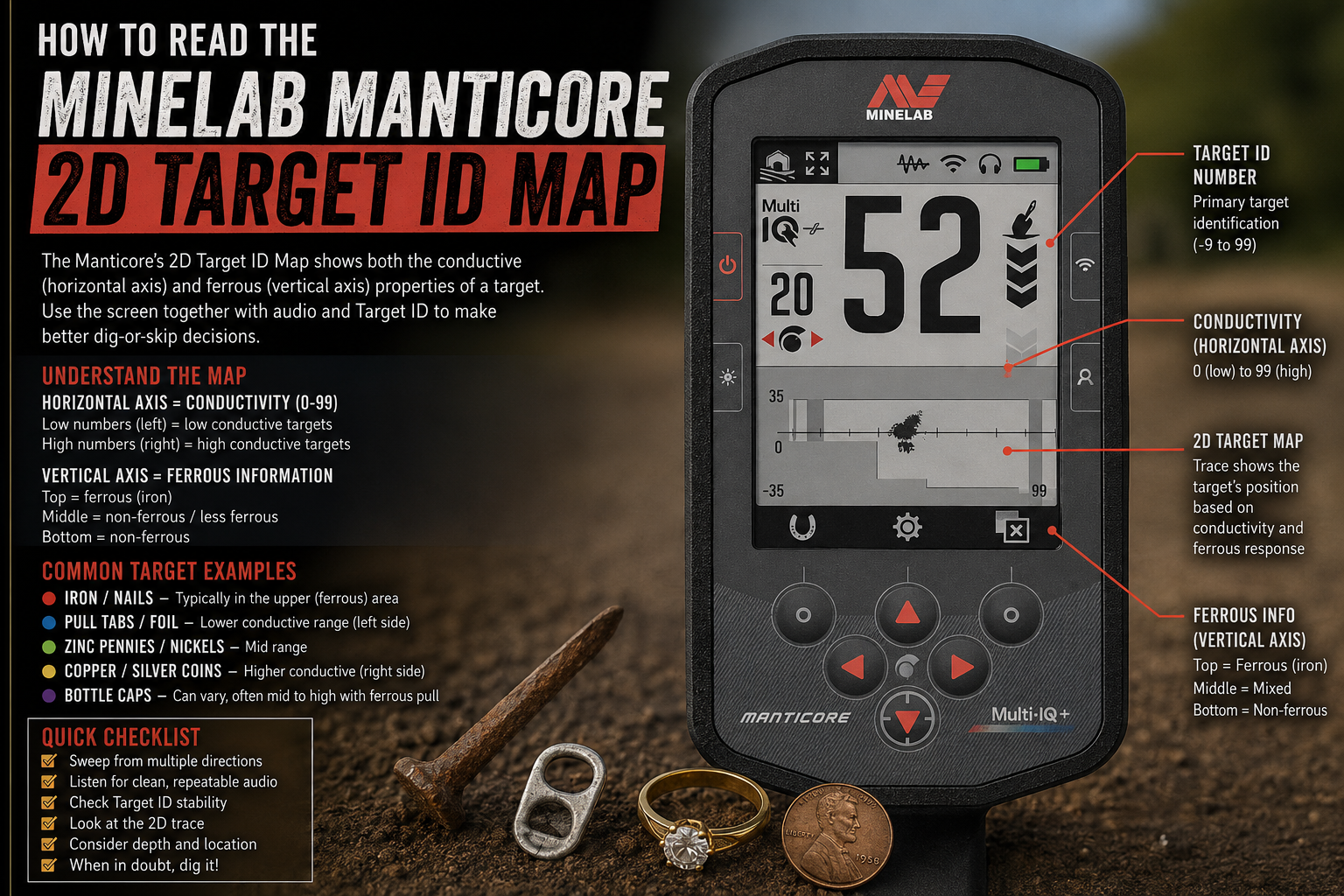
The Minelab Manticore’s 2D Target ID Map provides more information than a Target ID number alone. Learn how to interpret target traces, recognize possible iron and bottle caps, identify promising coin signals, and make better digging decisions.

The Minelab Manticore gives detectorists more target information than a conventional Target ID number alone. Its advanced 2D Target ID Map displays both the conductive and ferrous characteristics of a detected object, helping you make a more informed decision before you start digging.
However, the screen is not a magic target-identification system. A silver coin will not always produce a perfect dot, and a bottle cap will not always look exactly the same. Target depth, orientation, soil conditions, nearby iron, sweep direction and detector settings can all change the trace.
The key is learning how to combine the Manticore’s 2D screen, Target ID number, audio response and repeatability. When those pieces begin telling the same story, your confidence in a target can improve dramatically.
Considering a Minelab Manticore?
Talk with Bart before ordering for current Manticore packages, unadvertised options and help choosing the right coil for the places you hunt.
Call or text: 405-206-9010
Email: Bart@BigBoysHobbies.net
Shop: Minelab Manticore at Big Boys Hobbies
Quick Jump
- What is the Manticore 2D Target ID Map?
- How to read the 2D map
- What a coin signal may look like
- How bottle caps and iron may appear
- What happens when a coin is near a nail
- Why you should not hunt by the screen alone
- Settings that affect target traces
- Choosing the right Manticore coil
- Quick field checklist
- Frequently asked questions
What Is the Minelab Manticore 2D Target ID Map?
The Manticore’s 2D Target ID Map plots a detected target according to two basic types of information:
- Conductivity: Displayed from 0 to 99 across the horizontal portion of the screen.
- Ferrous characteristics: Displayed vertically to help show whether the target has iron-like properties.
Instead of showing only a Target ID number, the Manticore produces a visible Target Trace. Depending on the target and conditions, that trace may appear as a tight dot, a wider mark, an irregular smear or multiple traces.
This additional information can help you evaluate targets that produce similar Target ID numbers but have very different physical characteristics. For example, a coin and a piece of oddly shaped trash may occasionally fall into a similar conductive range, but their audio response and 2D trace may tell different stories.
That is one reason the Manticore has become such a popular choice among serious coin, jewelry, relic and beach hunters. It does not simply give you another number—it gives you another layer of information to interpret.
How to Read the Manticore 2D Target ID Map
Horizontal Position: Target Conductivity
The horizontal scale runs from 0 to 99. Lower-conductive targets generally appear farther to the left, while higher-conductive targets appear farther to the right.
Lower and middle conductors can include:
- Small gold jewelry
- Nickels
- Thin jewelry
- Small brass items
- Buttons
- Pull tabs and aluminum trash
Higher conductors can include:
- Copper cents
- Clad dimes and quarters
- Silver coins
- Large brass and copper objects
- Some larger aluminum targets
Conductivity alone cannot tell you exactly what is under the coil. Gold jewelry, aluminum trash and many desirable relics can overlap. That is why experienced detectorists combine the number with the trace, tone, depth and repeatability.
For examples of common coin, jewelry and relic readings, see our complete Minelab Manticore Target ID List.
Vertical Position: Ferrous Information
The vertical position helps display the target’s ferrous characteristics. Targets with stronger iron-like properties may pull away from the center conductive line and produce traces in the ferrous portions of the display.
The Manticore’s adjustable Ferrous Limits determine how much of those areas are accepted or rejected. These limits can be adjusted to suit the location, target type and amount of iron in the ground.
A target touching or entering a ferrous area is not automatically worthless. Good targets located beside nails, coins on edge, deep targets and oddly shaped relics can produce imperfect traces. Treat the ferrous information as evidence—not an automatic verdict.
Trace Shape and Strength
The shape and intensity of the trace can provide more clues:
- Tight trace: May indicate a compact, consistent target such as a coin or ring.
- Wide or smeared trace: May indicate an irregular target, multiple objects or a target affected by nearby iron.
- Multiple traces: May indicate more than one object under the coil.
- Weak or faint trace: May be caused by depth, a very small target or a target at the edge of detection.
Important: No trace shape guarantees a particular target. The 2D map is most useful when it agrees with the audio response, Target ID and repeated sweeps from more than one direction.
What Does a Coin Look Like on the Manticore 2D Screen?
A shallow, flat coin in relatively clean ground may produce one of the easiest signals to recognize. You may see a fairly tight trace near the center conductive line, along with a repeatable Target ID and clean audio response.
A promising coin signal will often have several of these characteristics:
- A compact or reasonably tight Target Trace
- A repeatable Target ID range
- Clean audio from more than one sweep direction
- A response that remains centered as you shorten the sweep
- A pinpoint response that suggests a compact object
However, do not expect every coin to look perfect. Several conditions can make a good coin produce a less attractive trace.
Why a Good Coin Signal May Look Messy
- The coin is deep: As signal strength decreases, the trace and Target ID may become less stable.
- The coin is on edge: Its apparent conductivity and target response can change with sweep direction.
- Iron is nearby: A nail or other ferrous object can pull or smear part of the trace.
- There are multiple targets: The screen may attempt to display more than one object.
- The ground is mineralized: Difficult soil can reduce Target ID accuracy and stability.
- The sweep is too fast: Fast, wide swings can make closely spaced targets blend together.
When a signal sounds promising but the screen is not perfect, rotate around it and sweep from another direction. A masked coin may become much clearer when the coil crosses the target from a better angle.
How Bottle Caps and Iron May Appear
Bottle caps are some of the most frustrating targets for coin hunters because certain caps can imitate a good conductive signal. Their round shape can make them sound better than ordinary iron, especially when they are rusty, flattened or buried at an angle.
On the Manticore, a bottle cap or irregular iron target may produce:
- A trace that stretches or smears into a ferrous area
- A good tone mixed with an iron response
- A Target ID that jumps more than a typical coin
- A trace that changes significantly when swept from another direction
- A wider or less concentrated response than a coin
- A signal that breaks up when the coil is moved slightly off center
None of those signs proves that the target is trash. A good target next to iron can behave similarly. The goal is to look for a pattern across several pieces of information.
A Practical Bottle-Cap Test
When you suspect a bottle cap, try this process:
- Center the target using short, controlled sweeps.
- Watch whether the trace stays concentrated or pulls into the ferrous area.
- Rotate approximately 90 degrees and sweep again.
- Listen for iron or a rough edge around the good tone.
- Raise the coil slightly and see whether the response changes unusually.
- Consider the location and the likelihood of coins versus modern trash.
In a modern picnic area filled with caps, you may decide to be more selective. At an old homesite where a questionable signal could be a valuable coin or relic beside a nail, it often makes sense to dig more of those imperfect targets.
What Happens When a Coin Is Beside a Nail?
This is where the Manticore’s combination of fast response, detailed audio and the 2D Target ID Map can become especially useful.
When a coin and nail are close together, you may see:
- Two separate traces
- A conductive trace with a ferrous smear
- A good tone mixed with an iron response
- A Target ID that improves from one direction
- A signal that becomes clearer with a shorter sweep
Do not reject the target simply because iron appears on the map. You may actually be seeing both objects.
Slow down, shorten your sweep and rotate around the signal. Try to isolate the nonferrous response. A good target may only reveal itself through a small portion of the sweep, particularly in old homesites, nail-filled relic locations and heavily hunted parks.
Coil Choice Can Make a Difference
The standard M11 coil is an excellent all-around option and provides a useful balance of coverage, depth and separation. In dense trash or iron, however, a smaller or narrower coil can make it easier to separate nearby targets.
For many of the parks and iron-filled sites I hunt, I use the Minelab Manticore M9 coil. Its controlled footprint makes it easier to work between nearby targets while maintaining excellent everyday performance.
You can read more about my experience with that setup in Why I Switched to the M9 Coil on My Manticore.
Do Not Hunt Using the Screen Alone
The Manticore’s display is one of its biggest advantages, but your ears still matter. In fact, some of the most valuable targets may not produce textbook Target ID numbers or perfectly shaped traces.
A better dig-or-skip decision considers all of the following:
- Audio quality: Is there a clean, repeatable nonferrous tone?
- Target ID: Does the number remain within a reasonable range?
- 2D trace: Is it tight, smeared, split or pulled toward iron?
- Repeatability: Does the signal repeat from multiple directions?
- Target size: Does the response seem coin-sized or unusually large?
- Depth: Is the weaker response reasonable for the indicated depth?
- Location: Are you hunting a modern trash area or a historic site where questionable targets deserve investigation?
Bart’s Basic Rule
Use the screen to support what you hear—not to replace it. When the tone, Target ID, trace and repeatability agree, you can dig with more confidence. When they disagree at a historic location, investigate the signal before walking away.
Manticore Settings That Affect the 2D Target Trace
The same buried object can appear differently when you change search modes, sensitivity, recovery speed, discrimination or Ferrous Limits. Understanding these adjustments will help prevent you from treating the screen as an unchanging picture.
Sensitivity
Higher sensitivity can help detect weaker and deeper targets, but running it too high may increase instability, ground noise and unwanted responses. If the screen becomes excessively busy or the detector sounds erratic, lowering sensitivity slightly may provide cleaner information.
Recovery Speed
The Manticore offers recovery-speed adjustments from 0 to 8. Higher settings can help separate closely spaced targets in trash, while lower settings may improve the response on deeper, isolated targets.
There is a trade-off. Running recovery speed too high for the conditions may weaken deeper responses. Running it too low in heavy trash may cause adjacent targets to blend together.
Ferrous Limits
Ferrous Limits determine how the detector classifies and responds to targets in the ferrous portions of the map. More aggressive rejection can quiet an iron-filled site, but it can also make it easier to miss a desirable target that is being influenced by nearby iron.
In difficult locations, avoid copying someone else’s settings without considering your ground, coil, target types and hunting style. Use a starting point, test known targets and make small adjustments.
Search Mode
The Manticore includes modes designed for different environments, including all-terrain, beach and goldfield conditions. Each mode uses settings intended for a particular type of ground and target response.
Use a mode appropriate for the location before making major changes. A setting that works well in a clean field may not be ideal for a trashy park, wet salt sand or iron-filled homesite.
Sweep Speed and Coil Control
Detector settings are only part of the equation. Coil control has a major effect on the information you receive.
- Keep the coil level throughout the sweep.
- Avoid lifting it at the end of each swing.
- Overlap your passes.
- Shorten the sweep when investigating a target.
- Slow down in dense trash and iron.
- Rotate around questionable signals.
The Manticore can process targets quickly, but no detector can properly separate targets if the coil is rushed through a contaminated site without enough control.
Choosing the Right Minelab Manticore Coil
The best Manticore coil depends on the type of ground you cover, the amount of trash and iron present, and whether you value maximum separation, all-around performance or additional ground coverage.
Minelab M8 Coil
The Minelab Manticore M8 8-inch by 5.5-inch DD coil is the smallest Manticore coil. Its narrow footprint is useful in extremely trashy sites, around heavy iron, between rocks and in tight spaces.
The M8 can help isolate targets that may blend together under a larger coil. The trade-off is less ground coverage and potentially less depth on some targets than a larger coil.
Minelab M9 Coil
The Minelab Manticore M9 coil provides an excellent balance of target separation, depth, weight and coverage. It is my preferred everyday Manticore coil for many parks and older locations where trash and iron are common.
It is easier to maneuver than the stock M11 while still covering more ground than the smaller M8. For many hunters, the M9 can be the most versatile optional coil in the Manticore lineup.
Minelab M15 Coil
The Minelab Manticore M15 15-inch by 12-inch DD coil is designed for greater ground coverage and strong performance in more open locations.
It can be a good option for fields, beaches, pasture and other areas where targets are more spread out. The larger size allows you to cover more ground with every sweep, although it may not separate closely spaced targets as easily as the M8 or M9.
| Manticore Coil | Best Use | Main Advantage |
|---|---|---|
| M8 Coil | Heavy trash, iron and tight spaces | Maximum separation and maneuverability |
| M9 Coil | Parks, homesites and everyday detecting | Excellent balance of separation, depth and coverage |
| Standard M11 | General-purpose and beach detecting | Strong all-around performance |
| M15 Coil | Fields, beaches and open ground | Maximum coverage and strong open-ground performance |
Quick Manticore 2D Map Reference
| What You Notice | What It May Mean | What to Do Next |
|---|---|---|
| Tight trace and repeatable tone | Compact, consistent target such as a coin or ring | Sweep from another direction and dig if it remains consistent |
| Trace smears toward a ferrous area | Iron, bottle cap or a good target influenced by nearby iron | Shorten the sweep and rotate around the target |
| Two visible traces | Two adjacent objects or a complex target | Try to isolate each response with controlled sweeps |
| Faint but repeatable trace | Deep, small or edge-of-detection target | Check from several angles and consider the location |
| ID and trace change dramatically by direction | Irregular trash, target on edge or multiple nearby targets | Pinpoint, shorten the sweep and investigate carefully |
Quick Field Checklist Before Skipping a Target
Before walking away from a questionable Manticore signal, run through this checklist:
- Sweep the target from at least two directions.
- Shorten your sweep and try to isolate the center.
- Listen for a repeatable nonferrous tone.
- Watch whether the trace remains tight or moves into the ferrous area.
- Check whether the Target ID stays within a reasonable range.
- Consider whether the target could be deep, tilted or beside iron.
- Lower sensitivity slightly if the detector is unstable.
- Use the location’s age and history to decide how selective to be.
- When in doubt at a promising historic site, dig it.
Is the Manticore’s 2D Target ID Map Worth It?
For detectorists who want more information before digging, the 2D Target ID Map is one of the strongest reasons to choose the Minelab Manticore.
It will not identify every buried object with certainty, and it does require time in the field to understand. However, once you learn how the traces relate to the audio, Target ID and surrounding conditions, the screen can help you:
- Recognize compact, consistent targets more quickly
- Notice iron mixed with conductive targets
- Separate multiple objects under the coil
- Investigate questionable signals more methodically
- Reduce some unnecessary digging in modern trash
- Make better decisions in difficult and heavily hunted locations
The Manticore remains an excellent choice for serious coin, jewelry, relic, field, park and beach hunting. It combines advanced target information with strong depth, fast response, adjustable recovery speed, flexible Ferrous Limits and multiple search modes.
For a detailed comparison with another popular Minelab detector, read Minelab Manticore vs. Equinox 900: Which Flagship Is Best for You?.
Get the Right Manticore Setup
The best Manticore setup depends on where you hunt. The stock M11 is an excellent all-purpose and beach coil, the M8 excels in extremely tight trash, the M9 is my preferred choice for many parks and iron-filled sites, and the M15 provides additional coverage in open ground.
Contact me before ordering and I will help you choose the correct detector and coil package for your hunting conditions.
Call or text Bart: 405-206-9010
Email: Bart@BigBoysHobbies.net
Minelab Manticore 2D Target ID Map FAQ
What does the Manticore 2D Target ID Map show?
It displays both the conductive and ferrous characteristics of a detected target. Conductivity is shown from 0 to 99 horizontally, while the vertical position provides information about the target’s ferrous characteristics.
What does a good coin look like on the Manticore screen?
A coin in clean ground may produce a relatively tight trace, stable Target ID and repeatable audio response. Deep coins, tilted coins and coins beside iron may produce less consistent traces.
Can the Manticore identify bottle caps?
The 2D map and audio can help identify characteristics commonly associated with bottle caps, such as ferrous smearing or an inconsistent response. However, no detector can identify every bottle cap with complete certainty.
What does a smeared Target Trace mean?
A smeared trace can indicate an irregular object, iron, a bottle cap, multiple nearby targets or a desirable target being affected by adjacent iron. Rotate around the target and use short sweeps before deciding.
Should I dig a target that shows both ferrous and nonferrous information?
Possibly. You may be detecting a good target beside a nail or another piece of iron. At older sites, signals containing both types of information are often worth investigating.
Should I use the Target ID number or the 2D screen?
Use both, along with the audio response, depth, target size and repeatability. No single piece of information should make every digging decision for you.
Does recovery speed affect the 2D Target ID Map?
Yes. Faster recovery speeds can help separate nearby targets in trash, while slower settings may provide a stronger response on deep, isolated targets. The best setting depends on the location.
What is the best Manticore coil for trashy parks?
The M8 coil provides excellent separation in extremely dense trash and tight areas. I prefer the M9 coil for many everyday parks because it provides a strong balance of separation, depth and ground coverage.
Which Manticore coil is best for fields and beaches?
The stock M11 is an excellent general-purpose and beach coil. The larger M15 coil can provide greater coverage in open fields, pastures and beaches where targets are more spread out.
Where can I buy a Minelab Manticore?
You can purchase the Minelab Manticore from Big Boys Hobbies with free shipping, no sales tax outside Oklahoma and direct help from Bart before and after the sale.
Written by Bart Davis — Big Boys Hobbies Metal Detectors
Big Boys Hobbies is an authorized Minelab dealer offering real product support, free lifetime assistance and help choosing the right detector for your hunting style. Call or text Bart at 405-206-9010 with any questions about the Minelab Manticore.