


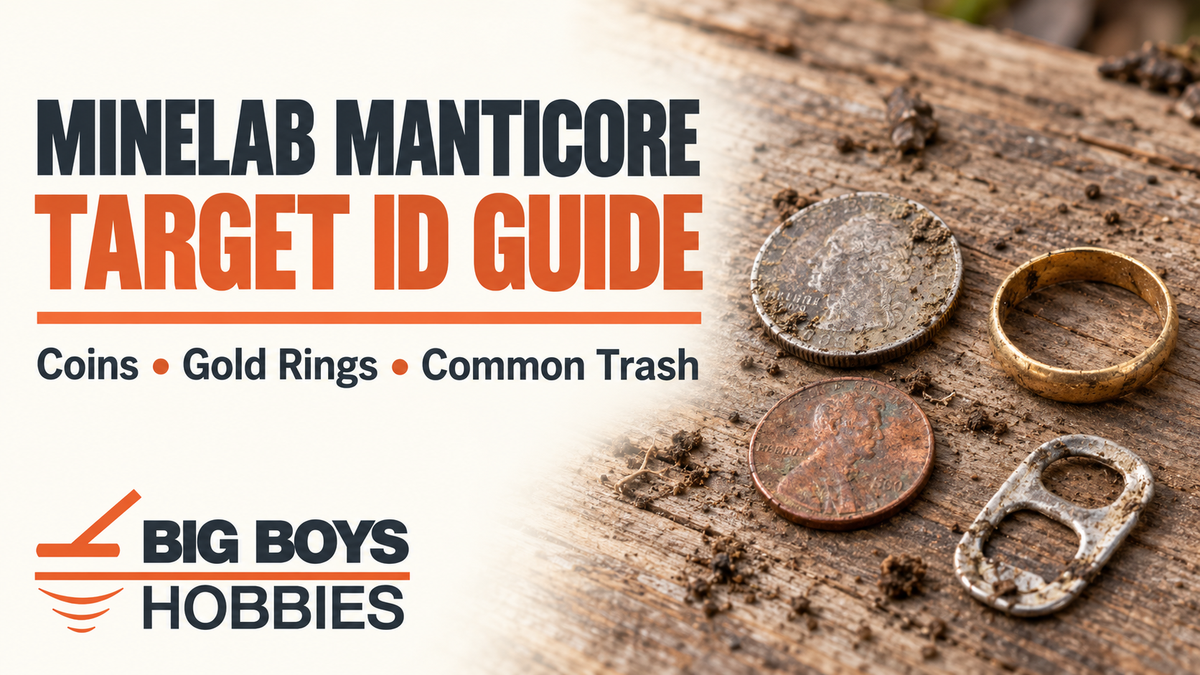
I like the target ID list for metal detectors, so I made one for the Minelab Manticore. Wondering what the numbers on your Minelab Manticore metal detector mean? This Manticore Target ID chart lists reported readings for coins, gold rings, relics, and common trash. Use it as a starting point, then consider the audio and 2D Target Trace before deciding whether to dig.
Jump to: Full Target ID chart | Coin IDs | Gold rings and pull tabs | Reading the 2D display | FAQs
Minelab Manticore Target ID Reference Chart
The table below preserves the reported numerical and personal readings in our original list. Descriptions such as “choppy” refer to the reported response of that example; they are not rules for identifying every similar object.
| Target ID | Reported target / response |
|---|---|
| 12–16 | Nickel three-cent piece |
| 20–23 | $1 gold piece |
| 21–23 | Beaver-tail pull tab |
| 24–25 | Buffalo nickel |
| 25–27 | 1980 nickel |
| 26–27 | V nickel |
| 28–29 | 14k white-gold men's band |
| 28–30 | Rectangular pull tab — reported choppy response |
| 29 | Silver war nickel |
| 30 | Platinum men's ring |
| 30–40 | Reported gold-ring examples — not a universal gold range |
| 31–33 | Whole ring tab |
| 34–36 | Ring tab — ring only |
| 34–36 | Zip tab — partial |
| 35–36 | Eagle button |
| 35–37 | Whole zip tab |
| 36–38 | Square nails — reported choppy response |
| 38 | Steel bottle cap — reported choppy response |
| 37–38 | $2.50 gold piece (Quarter Eagle) |
| 43–44 | Round ring pull tab with tail — reported choppy response |
| 44–45 | 1862 copper-nickel Indian Head cent |
| 45–47 | 1853 silver three-cent piece |
| 49–53 | $5 gold piece (Half Eagle) |
| 50–52 | Musket ball |
| 51–53 | Modern rectangular pull tab |
| 52–53 | Small flat round buttons |
| 54–56 | 1889 bronze Indian Head cent |
| 58–59 | Badly corroded 2000 zinc cent |
| 58–61 | Half dime |
| 60–61 | Reported Indian Head / zinc-cent examples |
| 61–63 | Flat button |
| 62 | Reported wheat-cent / Indian Head examples |
| 65 | $10 gold piece (Eagle) |
| 66–71 | Two-cent piece |
| 69–70 | 1785 Charles III half real |
| 71–72 | Medium crotal bell |
| 75–76 | Worn thin silver dime |
| 76–77 | 1957-D wheat cent |
| 76–78 | $20 gold piece (Double Eagle) |
| 77–78 | Clad dime |
| 79–81 | 1786 Charles III half real |
| 81 | 1762 two reales |
| 82–85 | Silver dime |
| 88–89 | Clad quarter |
| 88–90 | Worn / holed 1799 George III halfpenny |
| 89–90 | Silver quarter |
| 89–90 | Sacagawea dollar |
| 92–93 | Silver half dollar |
| 93 | Kennedy half dollar |
| 93–95 | 1851 large cent |
| 95–96 | 1971 Eisenhower dollar |
| 96 | 1922 silver dollar |
Thinking About Getting a Manticore?
Compare our Minelab Manticore packages and current offers at Big Boys Hobbies. Have questions about the detector or want help choosing your accessories? Call or text Bart before ordering.
What Numbers Do Coins Read on a Manticore?
In the reported examples above, Buffalo and V nickels fall around 24–27, a clad dime reads 77–78, silver dimes read 82–85, and clad or silver quarters fall around 88–90. These examples give you useful reference points, but they do not make those numbers exclusive to coins.
Pennies deserve extra attention. The list includes widely differing readings for Indian Head and wheat cents. Composition, corrosion and the conditions behind individual reports can matter. Treat those entries as separate examples rather than combining them into one guaranteed penny range.
Build your own reference: Test known coins with the coil and search mode you normally use. Record the numerical ID, audio and target trace. An air test is useful for learning responses, but it does not reproduce every buried-target situation.
What Target ID Is Gold on the Manticore?
There is no single Manticore Target ID for gold. The list includes a reported white-gold men's band at 28–29 and other gold-ring examples at 30–40. Those readings do not cover every ring: size, shape and alloy can produce different responses.
Can You Separate Gold Rings From Pull Tabs by Number?
Not reliably. Gold jewelry and aluminum trash can share similar conductive IDs. A smooth, repeatable signal can be worth investigating, but a pull tab can also sound clean. Rejecting every pull-tab number can mean passing over jewelry.
Compare the number, sound and target trace, then sweep from another direction. Digging and checking the recovered object is how you confirm what it actually is.
How to Read the Manticore Target ID and 2D Target Trace
The numerical Target ID describes the target's conductive response. The 2D display provides additional information about conductive and ferrous characteristics. Together with the audio, it gives you more evidence than the number alone.
- Check repeatability. Sweep across the target several times and watch how consistently the number and response return.
- Look at the trace. Note its position and shape. A trace near the conductive center line can be useful evidence, but it does not prove that a target is a coin or jewelry.
- Listen to the audio. Consider whether the response is clean, broken or mixed with ferrous sounds.
- Change your sweep direction. Turn roughly 90 degrees and compare the response. Nearby iron and overlapping targets can complicate the picture.
- Verify by digging. Compare the recovered item with your prediction and use that experience to learn your sites.
For detailed control explanations, consult Minelab's Manticore instruction manual for your installed software version. This chart supplements the manual and your own field experience.
Why Do Manticore Target ID Numbers Change?
A target may not match this chart exactly. Common reasons include:
- Depth and ground conditions: Weak signals and mineralized ground can make interpretation more difficult.
- Target orientation: An object lying on edge may respond differently from one lying flat.
- Nearby metal: Nails, tabs or another coin can create a mixed response.
- Composition and condition: Different alloys, corrosion and damaged targets can affect the reading.
- Detector setup: Search mode, frequency selection, coil choice and other settings can affect the response or how clearly you can interpret it.
When a signal is uncertain, compare several sweeps and directions rather than making the decision from one flashing number.
Minelab Manticore Target ID FAQs
Are These Official Minelab Target ID Numbers?
No. This is a collection of reported examples from our reference list, not an official Minelab identification table. Use the readings as a guide and verify them against known targets at your own sites.
What Does a Silver Quarter Read on the Manticore?
The reported silver-quarter example in this list reads 89–90. Other objects can fall in that range, and an actual quarter can respond differently under different conditions.
Can a Pull Tab Sound Like a Gold Ring?
Yes. Both can produce a clean response and overlapping Target IDs. Neither a smooth tone nor a particular number guarantees gold.
Should I Dig a Target With a Jumping ID?
A jumping ID alone does not settle the decision. Check the audio, trace and response from another direction. Deep targets and objects near iron can be difficult to interpret. Let your site, hunting goals and experience guide whether to investigate.
Will This Chart Match Every Coil and Search Mode?
Do not assume every setup will reproduce each example exactly. Test familiar objects with your own coil and mode, and keep notes for comparison.
Help Us Improve This Manticore Target ID List
Have a confirmed find to contribute? Email me at Bart@bigboyshobbies.net with a photo of the recovered target, its ID range, search mode, coil, software version, approximate depth, and whether the reading came from an air test or a buried target. Those details help make future additions more useful.
Need help choosing your detector? Explore our Minelab Manticore packages or call Bart at 405-206-9010.
Written by Bart Davis of Big Boys Hobbies. Big Boys Hobbies is an authorized Minelab metal detector dealer helping detectorists and gold prospectors across the United States.